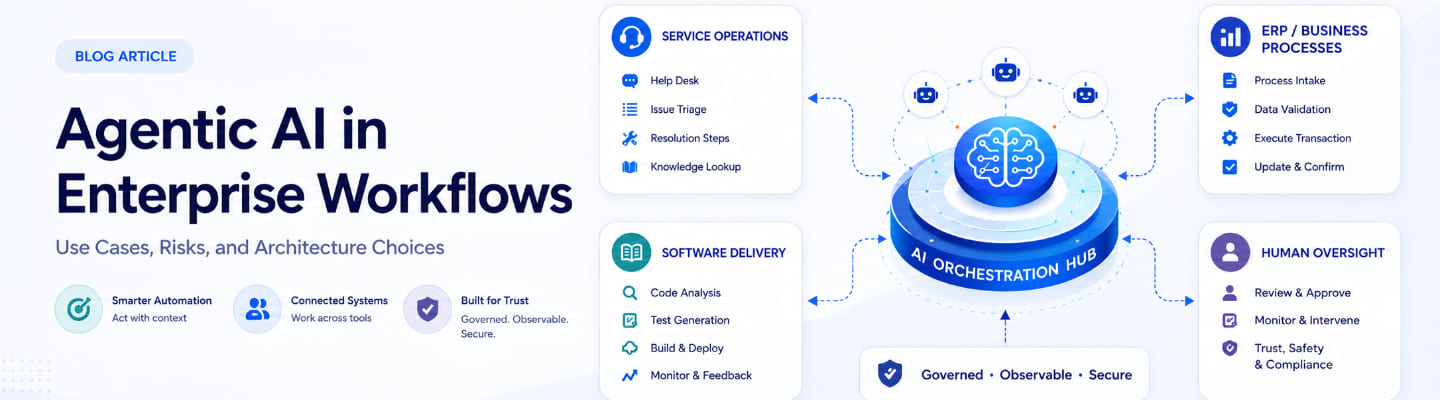
AI in the Enterprise: Practical Use Cases, Risks and Architecture Choices
Agentic AI is no longer just an experimental concept. It is becoming part of enterprise conversations about productivity, service operations, software delivery, ERP workflows, and business process transformation. The promise is strong: AI agents that can understand context, use tools, trigger actions, and support complex decisions. The risk is just as real.
Not every workflow needs an agent. Some workflows need simple automation. Some need better system integration. Some need cleaner data. Some need human control, not more autonomy. That is why agentic AI enterprise workflows should be designed with business logic first and AI capability second. The goal is not to add agents everywhere. The goal is to place them where they improve speed, accuracy, and decision support without creating operational risk.
Why Agentic AI Is Becoming a Boardroom Topic
Agentic AI is trending because enterprises are moving beyond AI assistants that only answer questions. Business leaders now want AI systems that can help execute work. Industry discussions around 2026 technology trends point in the same direction: AI is shifting from isolated pilots to production-level business impact.
Multiagent systems, AI-native platforms, and governed AI operations are becoming serious planning topics for enterprise teams. This matters because most companies already have automation. What they often lack is intelligent coordination across fragmented systems, scattered knowledge, and exception-heavy processes. That is where AI agents can help. They can:
- read and interpret business context;
- compare information from different systems;
- call approved tools and APIs;
- prepare recommendations;
- support users inside operational workflows;
- reduce manual coordination between teams.
But they must be governed carefully. An agent that acts without boundaries can create more work than it removes.
The Real Difference Between Agents and Automation
Workflow automation follows predefined rules. It is reliable when the process is stable. Agentic AI works differently. It can interpret information, choose between possible next steps, and adapt based on context. That flexibility creates value, but it also creates governance pressure. A practical decision model looks like this – use:
- workflow automation AI when the path is predictable.
- AI agents when the process requires judgment, context, or multi-step reasoning.
- human approval when the outcome affects money, compliance, security, customers, or employees.
A password reset request does not need an agent. A standard automated flow is enough. A complex IT service ticket with unclear cause, multiple systems, missing context, and possible business impact may benefit from an agent-supported workflow. The enterprise decision is not “agents or automation.” The right answer is usually a controlled mix of both.
Where Agents Deliver Practical Enterprise Value
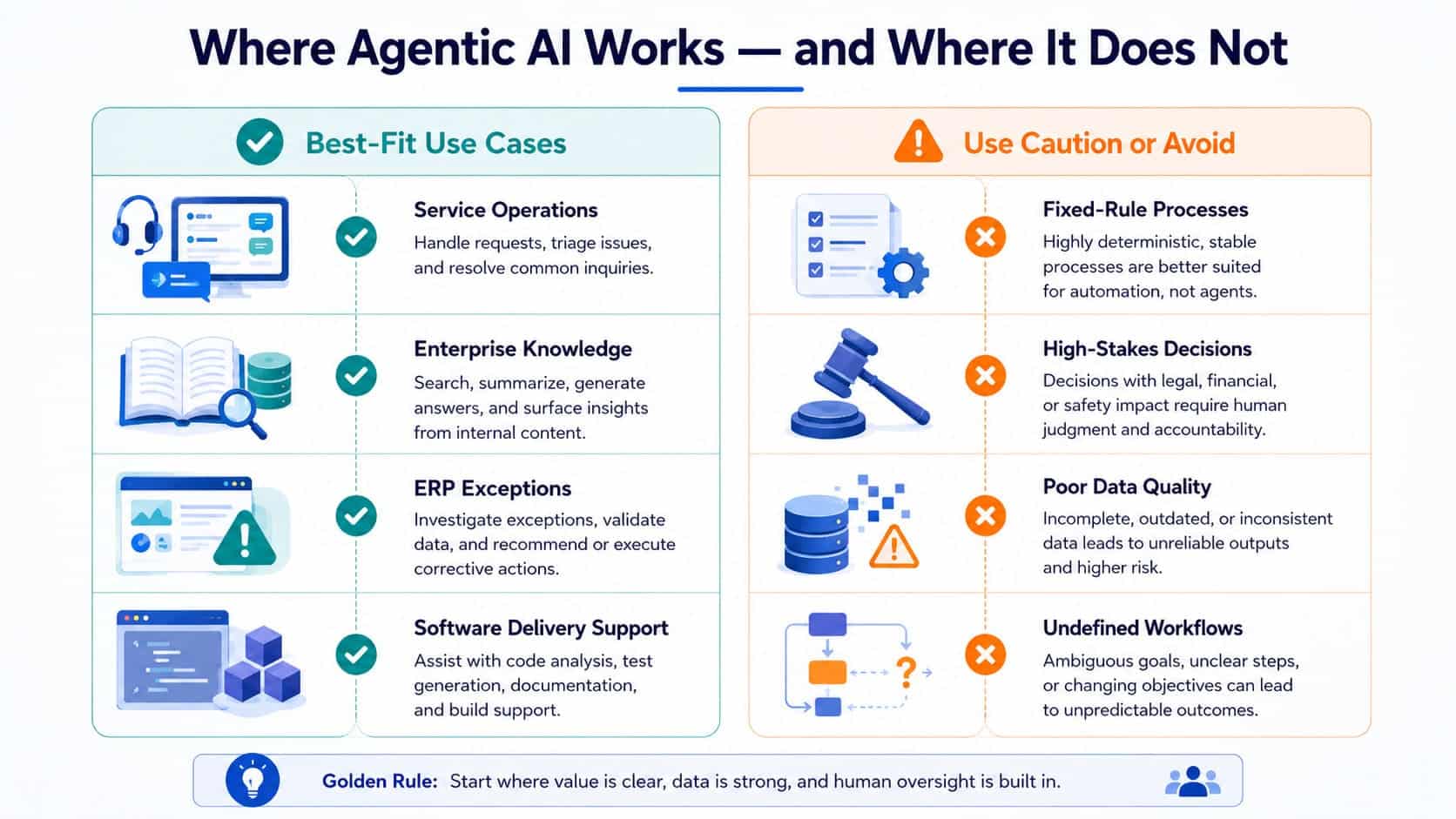
AI agents work best in workflows that are structured enough to govern but complex enough to justify intelligence. They are most useful when employees spend time on tasks such as:
- collecting context from several systems;
- switching between tools;
- interpreting incomplete information;
- managing exceptions;
- preparing recommendations;
- coordinating next steps across teams.
IT Service Management and Support Operations
Service teams handle large volumes of requests, incidents, and internal support cases. Many tickets are repetitive, but not always simple. An agent can support service operations by helping teams:
- classify incoming requests;
- detect urgency and business impact;
- suggest next steps;
- search knowledge bases;
- identify similar incidents;
- prepare response drafts;
- route cases to the right team.
In a ServiceNow environment, this can support faster triage and better routing without removing human control from critical decisions. For companies improving ITSM workflows, GFL supports ServiceNow implementation and support services.
ERP and SAP Process Assistance
SAP workflows often involve strict process rules, business exceptions, approvals, and cross-functional dependencies. Enterprise AI agents can help users:
- understand process steps;
- prepare data requests;
- check internal documentation;
- identify missing fields;
- support exception handling;
- reduce repetitive guidance requests.
The agent should not replace SAP as the system of record. Instead, it should operate as a guided support layer around SAP-controlled processes. GFL supports SAP application development and support for companies that need stable, integrated, and business-aligned enterprise systems.
Internal Knowledge and Decision Support
Enterprise knowledge is often distributed across documents, tickets, emails, reports, CRM records, ERP data, and internal platforms. AI agents can help teams gather information, summarize context, compare documents, and prepare structured recommendations. This is useful for departments such as:
- procurement;
- legal operations;
- HR;
- finance;
- customer support;
- sales operations;
- delivery management.
The best use case is not full decision replacement. It is faster preparation for better human decisions.
Software Delivery and Engineering Workflows
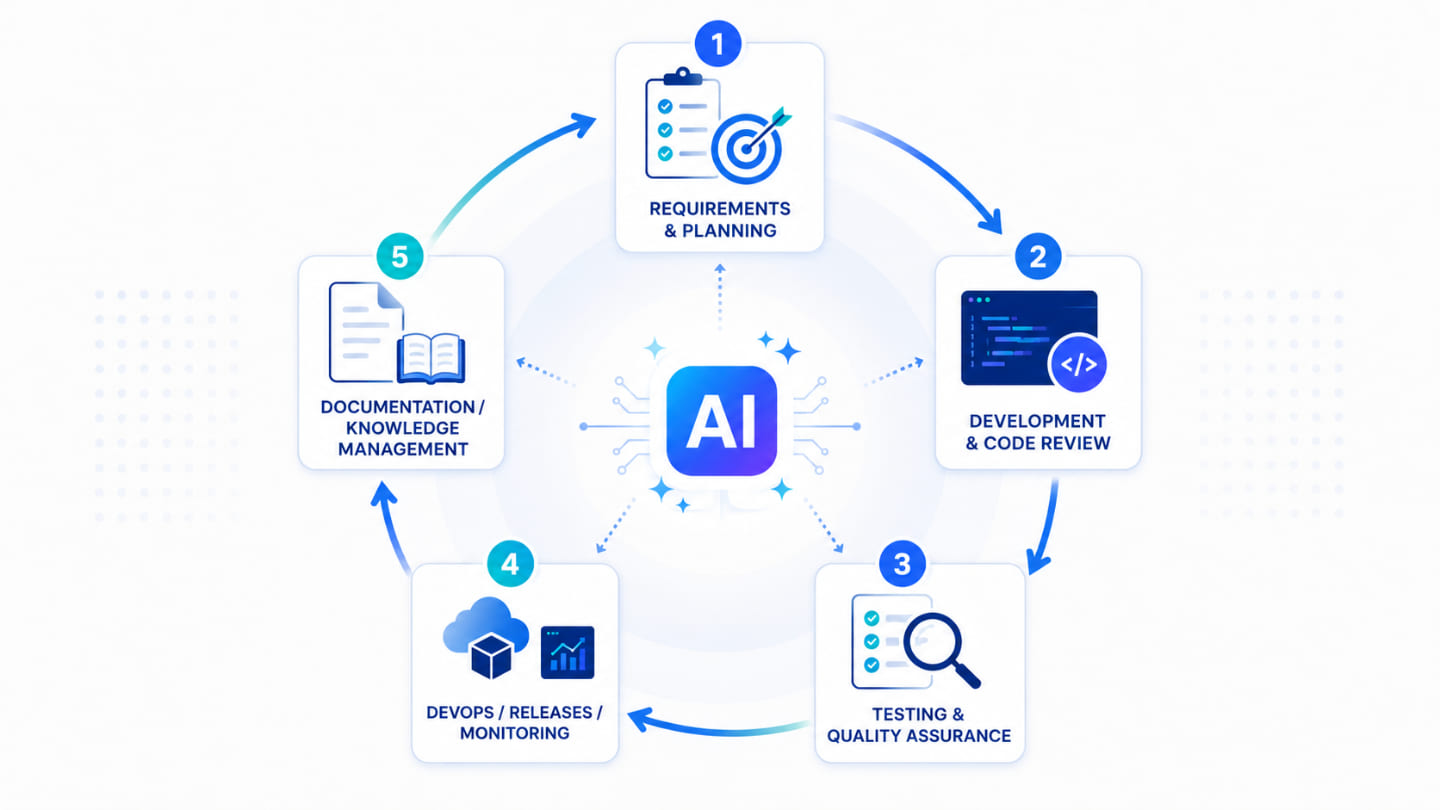
AI agents can support software teams by turning requirements into task drafts, generating test ideas, summarizing pull requests, checking documentation gaps, and assisting with release preparation. In software delivery, agents are especially useful for:
- Requirements clarification.
- Backlog preparation.
- Test scenario generation.
- Code review support.
- Release documentation.
- Engineering knowledge retrieval.
This does not replace engineering expertise. It reduces friction around planning, documentation, review, and coordination. For companies building custom AI-enabled systems, GFL provides software development services focused on architecture, integration, security, and long-term maintainability.
Cross-System Workflow Coordination
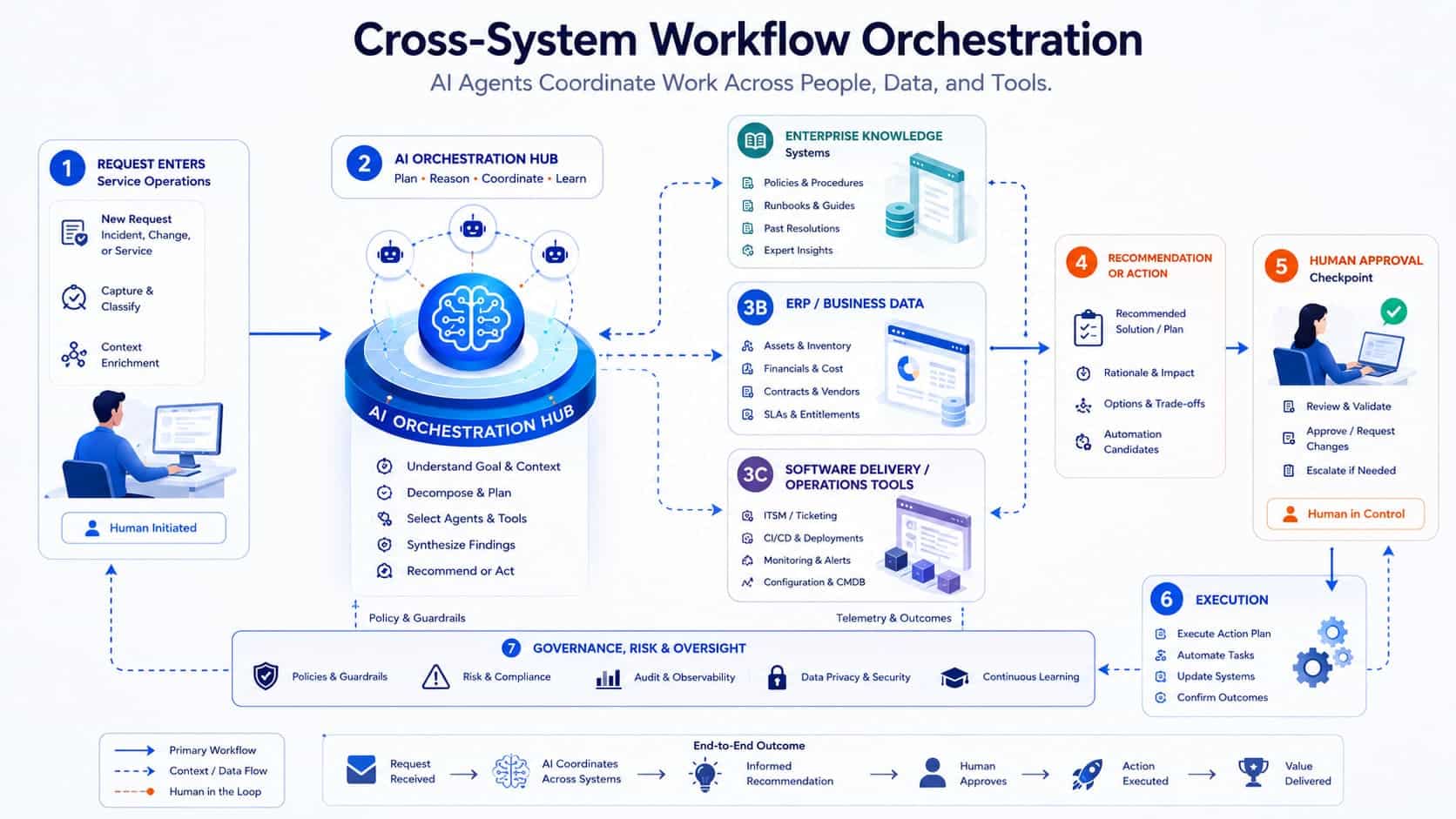
Many enterprise workflows break down because work moves across too many systems. A support request may involve ServiceNow, email, knowledge bases, ERP data, internal documentation, and approval tools. An agent can help coordinate these touchpoints when APIs, permissions, and action limits are clearly defined. This is where enterprise AI agents can create strong value. They do not simply answer questions. They help move work through a controlled process. A reliable cross-system agentic workflow usually requires:
- secure identity and access control;
- API-based integrations;
- clear tool permissions;
- action limits;
- audit logs;
- human approval gates;
- fallback scenarios;
- monitoring and error handling.
Where Agentic AI Does Not Work Well
Agentic AI becomes risky when companies apply it to the wrong workflow. The strongest AI strategy is not aggressive adoption. It is selective adoption.
Predictable Processes With Fixed Rules
If the process has a clear path, use automation. Good examples include:
- standard notifications;
- status updates;
- scheduled reporting;
- simple approvals;
- data synchronization;
- predefined routing.
Adding an agent to a simple process can increase cost, complexity, latency, and monitoring requirements.
High-Stakes Decisions Without Review
Agents should not independently make decisions with legal, financial, compliance, security, employment, or customer-impact consequences. They can support the process by:
- preparing analysis;
- flagging risks;
- comparing available data;
- drafting recommendations;
- identifying missing information.
But final approval should stay with accountable people or formally approved business rules.
Weak Data Foundations
Agents depend on the quality of the systems and information around them. If data is duplicated, outdated, poorly governed, or disconnected, the agent may produce confident but unreliable outputs. Before building agentic workflows, companies should define:
- Data ownership.
- Source-of-truth systems.
- Access rules.
- Integration logic.
- Data quality controls.
- Security boundaries.
Poorly Defined Business Processes
An AI agent cannot fix a broken operating model. If teams do not know who owns the workflow, what success looks like, or how exceptions should be handled, the first step is process redesign. Automating confusion only creates faster confusion.
Decision Matrix: Agent, Automation, Hybrid, or Human Control
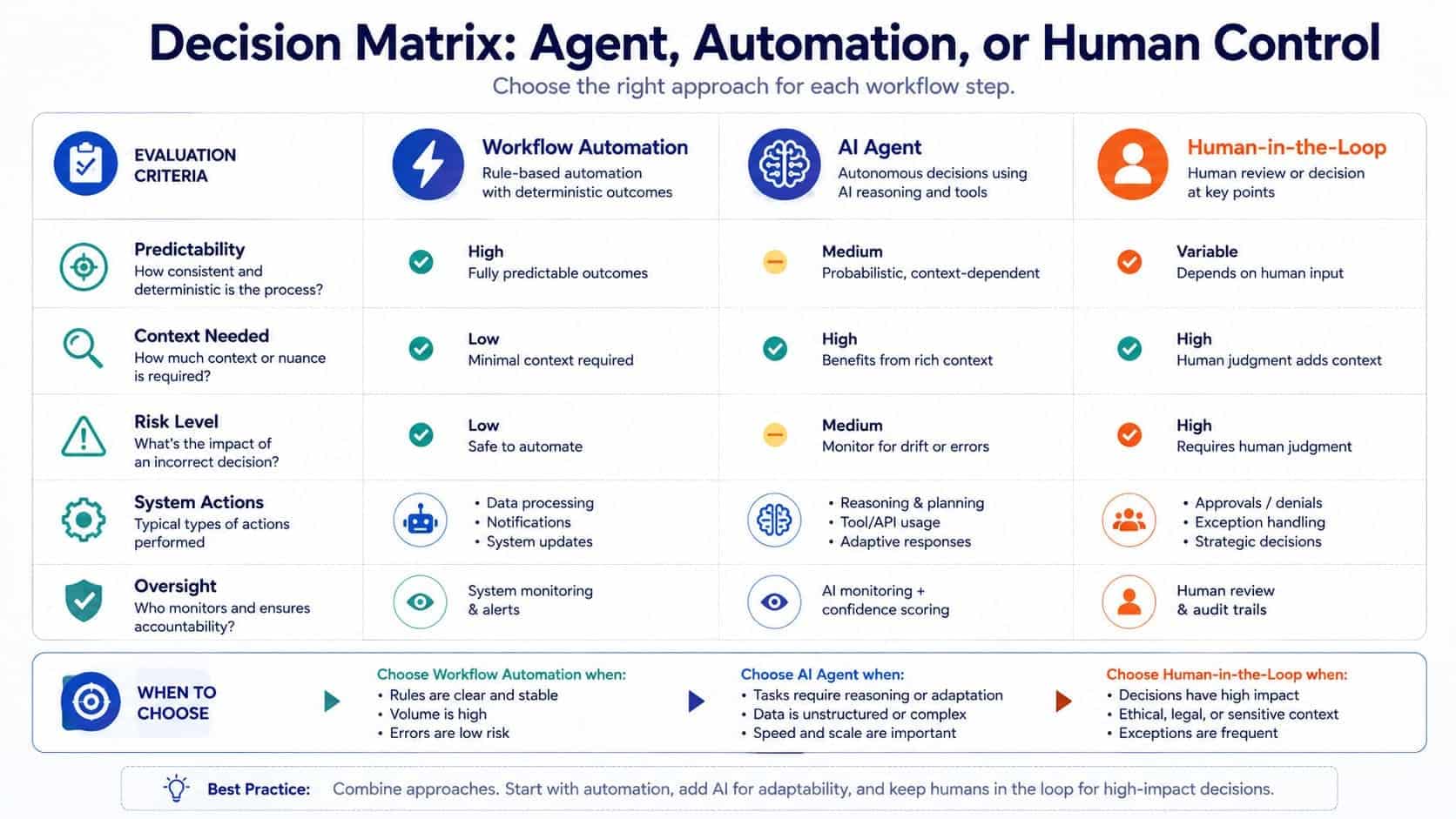
| Enterprise Situation | Best Approach | Practical Reason |
| Repetitive process with fixed rules | Workflow automation | Fast, predictable, low-risk |
| Process with unclear inputs and changing context | AI agent | Useful for interpretation and guided next steps |
| ITSM or support workflow with many ticket types | Hybrid | Automation routes; agents assist with triage and recommendations |
| SAP or ERP process with business exceptions | Hybrid | Core transaction stays controlled; agent supports users |
| Financial, legal, HR, or compliance decision | Human-in-the-loop | Accountability must remain clear |
| Poor data quality or fragmented records | Data cleanup first | Agents need trusted information |
| Cross-system workflow with APIs and permissions | Agentic workflow | Agent can coordinate tools within controlled limits |
| Manual process with unclear ownership | Process redesign | Governance must exist before AI execution |
The simplest rule: automate the predictable, augment the complex, and keep humans responsible for high-risk outcomes.
Architecture Choices for Enterprise Teams
Architecture should match the risk level of the workflow. A lightweight assistant and a multiagent system should not be treated the same way.
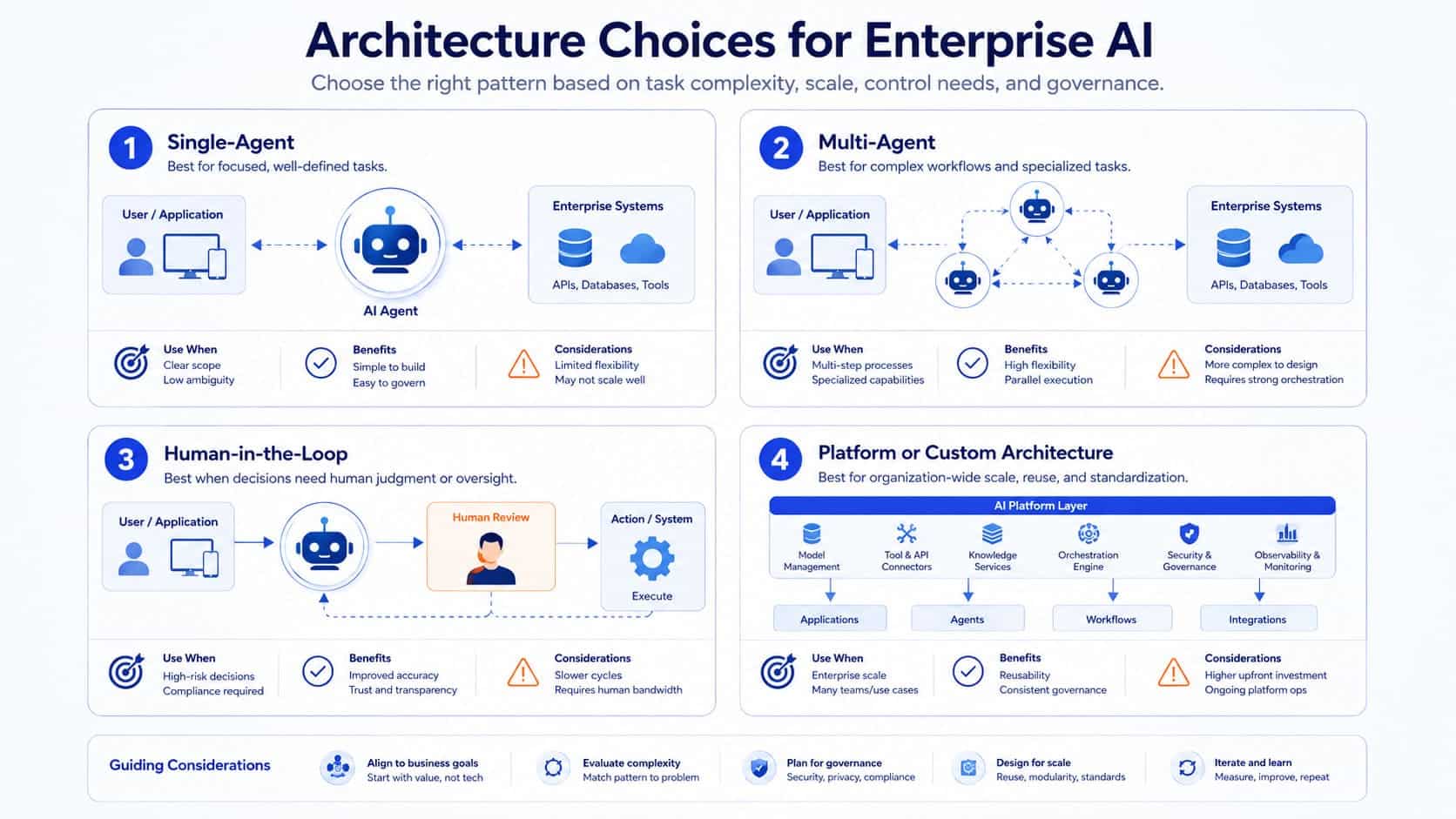
Single-Agent Architecture
A single-agent model is useful for focused workflows with clear boundaries. It can retrieve information, summarize cases, recommend actions, or prepare drafts. This is often the best starting point because it is easier to test, monitor, and govern. Use this model when:
- the task is narrow;
- the workflow has clear limits;
- the required tools are few;
- the output can be reviewed;
- risk exposure is moderate or low.
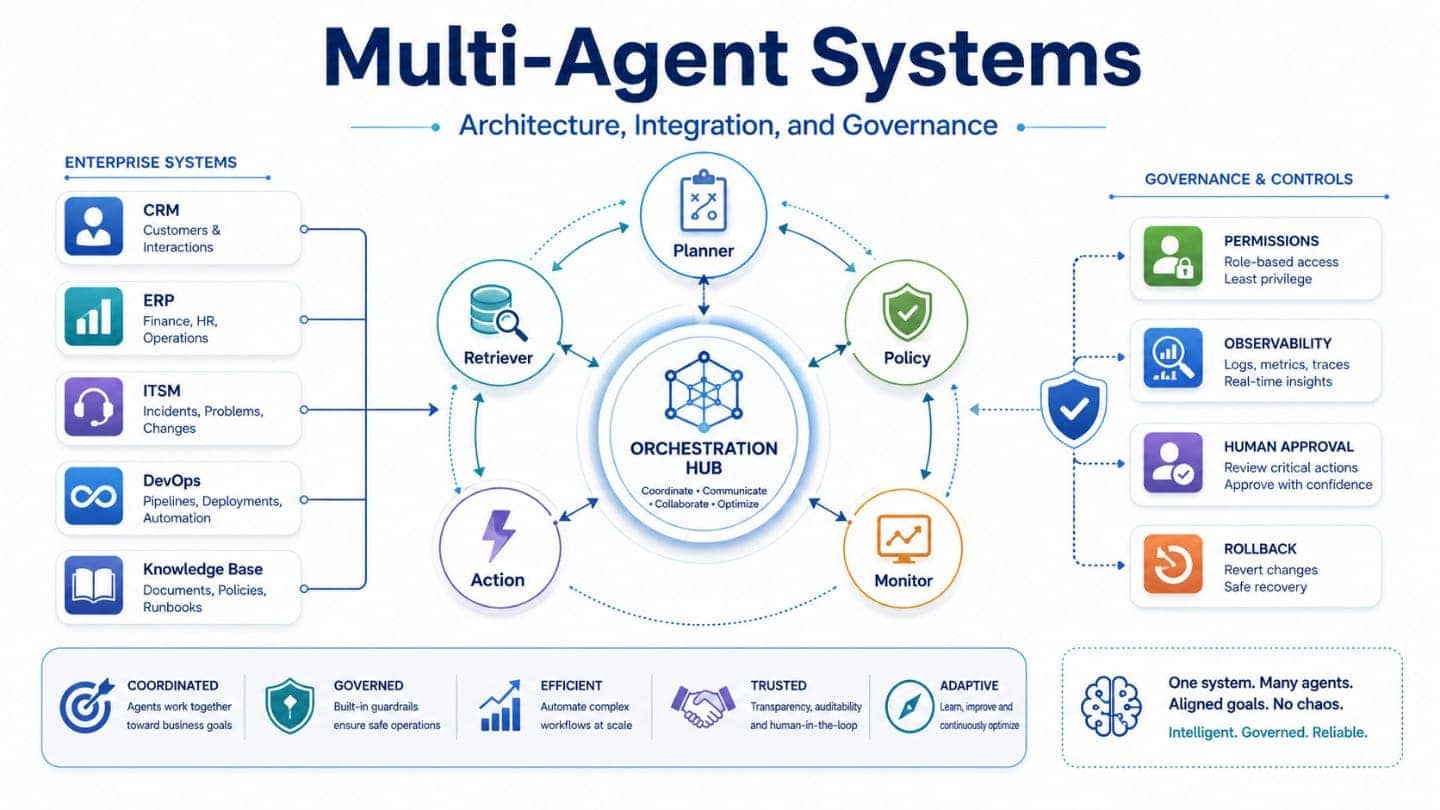
Multiagent Architecture
A multiagent system uses several specialized agents that work together. For example:
- One agent analyzes the request.
- Another checks internal documentation.
- Another validates data.
- Another prepares a recommendation.
- A human reviews the final output.
This model can be powerful, but it adds complexity. It should be used only when the workflow truly requires multiple specialized roles.
Human-in-the-Loop Architecture
This is often the safest model for enterprise adoption. The agent prepares the work. A human reviews, approves, rejects, or edits the result. This model is especially useful for:
- compliance-heavy processes;
- customer-facing responses;
- financial approvals;
- HR decisions;
- procurement exceptions;
- security-sensitive workflows.
Platform-Based Architecture
Low-code and enterprise platforms can accelerate agentic AI adoption when workflows are already structured inside systems like ServiceNow, Microsoft environments, CRM platforms, or ERP tools. The benefit is faster implementation. The limitation is less flexibility for highly customized logic.
Custom Architecture
Custom engineering is the right path when workflows require deep integrations, strict security, complex permissions, domain-specific logic, or advanced evaluation. This approach requires more planning, but it gives the enterprise more control over scalability, governance, and long-term performance.
Governance Must Be Designed Early
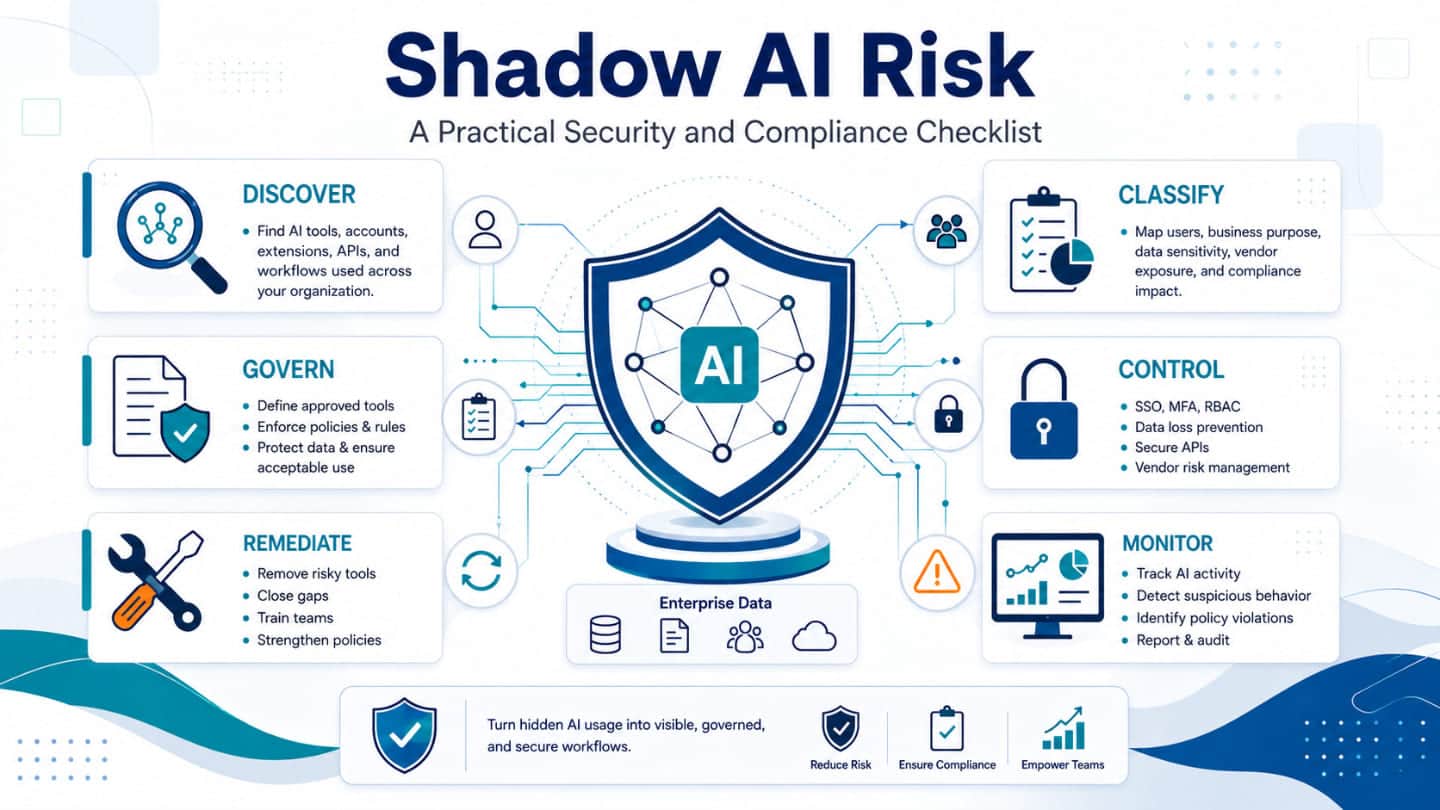
Agentic AI should not be deployed first and governed later. Governance must be part of the architecture from the beginning. A practical governance model should define:
- approved and restricted use cases;
- user roles and permissions;
- data access rules;
- API and tool limits;
- human approval points;
- audit trails;
- model and prompt versioning;
- output evaluation;
- cost monitoring;
- escalation paths;
- incident response;
- rollback procedures.
This is what turns agentic AI from a risky experiment into a controlled business capability.
A Safe Starting Path for Enterprise Adoption
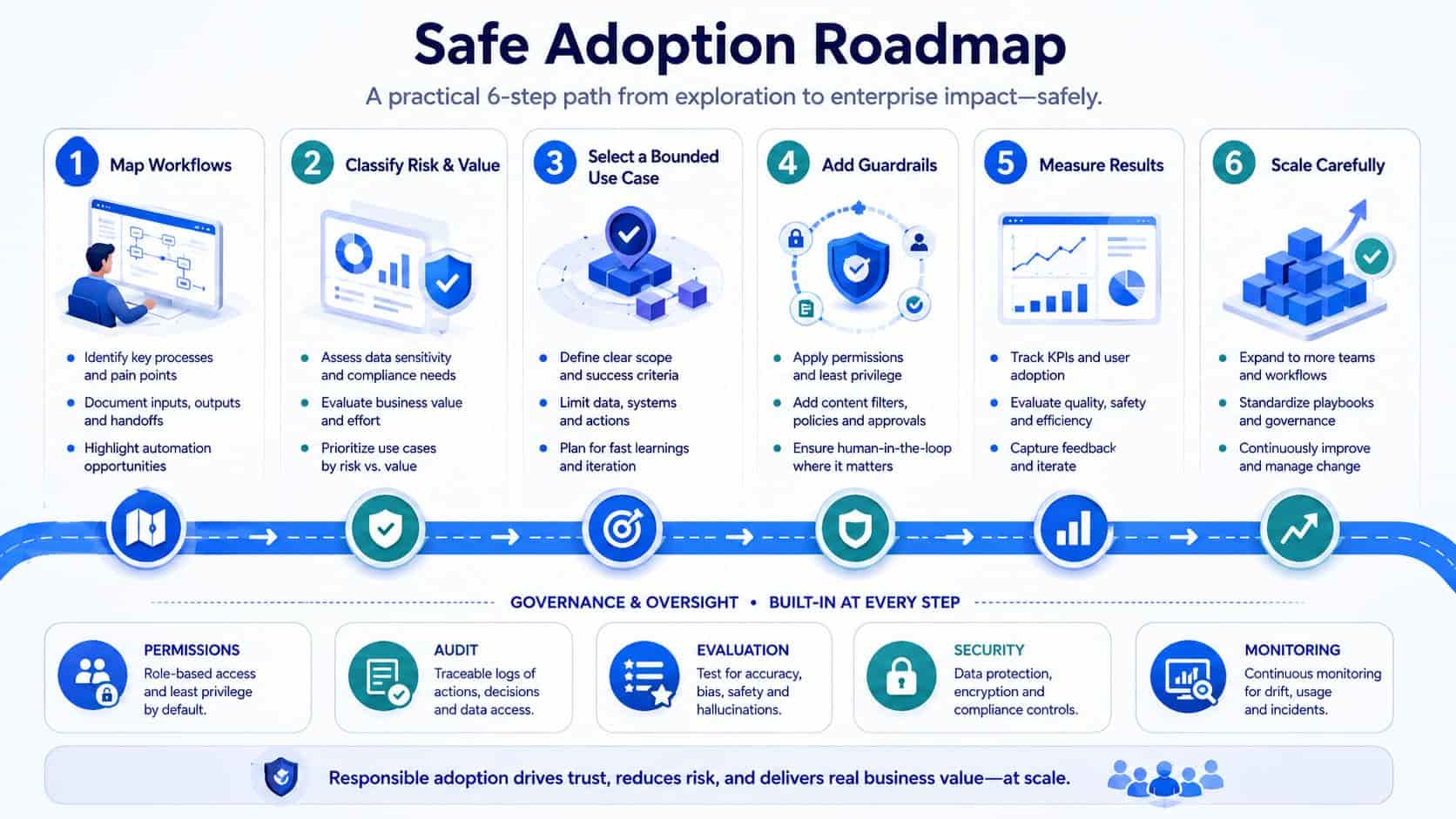
A company does not need to begin with a large AI transformation program. The better path is focused and practical.
- Map real workflows where teams lose time, repeat manual steps, or depend on scattered information.
- Classify each workflow by complexity, risk, data quality, and business value.
- Decide whether the workflow needs automation, an agent, a hybrid model, or human control.
- Select one or two bounded use cases.
- Build with secure access, human review, monitoring, and clear ownership.
- Measure the result before scaling.
- Expand only when the use case proves operational value.
Strong indicators include:
- faster ticket handling;
- fewer manual handoffs;
- reduced errors;
- better visibility;
- improved user experience;
- lower operational effort.
Agentic AI should grow from proven value, not internal pressure to follow a trend.
Build an AI Workflow Roadmap With GFL
Agentic AI can improve enterprise workflows, but only when it is applied with discipline. GFL helps companies separate practical opportunities from unnecessary complexity. Our teams support custom software development, ServiceNow workflows, SAP application support, system integration, automation, and AI-enabled enterprise solutions. We help enterprise teams define:
- where agents make sense;
- where workflow automation is enough;
- where human approval is required;
- what systems should be connected;
- what risks must be controlled;
- what architecture is needed for scale.
The outcome is a practical AI workflow roadmap built around business value, architecture, governance, and long-term maintainability.
Build an AI workflow roadmap with GFL.
FAQs
What are Agentic AI enterprise workflows?
Agentic AI enterprise workflows are business processes supported by AI agents that can understand context, use approved tools, retrieve information, recommend actions, or trigger controlled workflow steps.
Why does it matter for enterprise software?
It matters because enterprise software is moving from passive systems of record toward systems that help people coordinate work, reduce manual effort, and make faster decisions across complex environments.
How can a company start safely?
A company should start with a bounded workflow, clear metrics, limited data access, human approval points, monitoring, and a defined owner for the process.
What risks should be assessed first?
The first risks include data exposure, incorrect actions, weak permissions, lack of auditability, regulatory impact, unreliable outputs, integration errors, and unclear accountability.
How can GFL help?
GFL can assess enterprise workflows, identify the right AI and automation opportunities, design secure architecture, integrate business systems, and build a governed roadmap for agentic AI adoption.