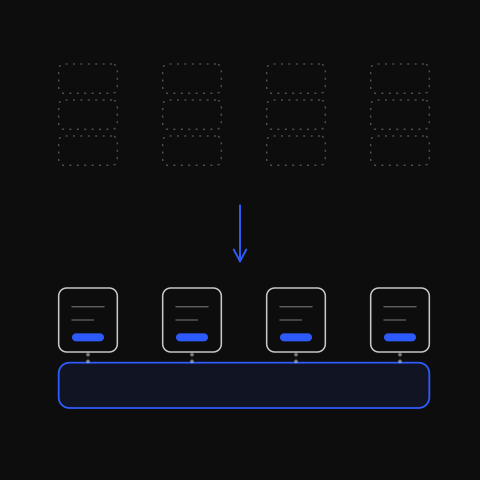
GeeksForLess (GFL) moves from technical uncertainty to a production-ready foundation through a focused three-stage process.
Define the Architecture
We plan your framework around business goals, technical requirements and your team’s needs.
Framework development company GeeksForLess (GFL) develops reusable software frameworks that standardize development, reduce duplicated engineering work and speed up product releases. We build secure technical foundations that help teams launch sooner, maintain code more easily and scale without expensive architectural overhauls.
We define the framework structure, modules, dependencies, and extension points around your product and delivery goals.
Shared components, services and development patterns reduce duplication and shorten every release cycle.
We establish clear coding conventions, testing requirements, documentation and governance across development teams.
Authentication, permissions, validation, logging and secure configuration are embedded directly into the framework architecture.
Our modular foundations support new products, integrations, users and business processes without disruptive redevelopment.
GeeksForLess provides tooling, documentation, onboarding, upgrades and long-term support for confident framework adoption.
GeeksForLess (GFL) moves from technical uncertainty to a production-ready foundation through a focused three-stage process.
We plan your framework around business goals, technical requirements and your team’s needs.
We build core modules, APIs, libraries, UI components, automation and clear coding.
We test your framework, integrate it into delivery workflows and help your team adopt it.
At GeeksForLess, we build frameworks around your workflows and technical requirements. We help your teams reuse code, simplify maintenance and release updates faster:
From architecture design to full-scale adoption, GeeksForLess (GFL) builds custom frameworks that eliminate repetitive development, standardize engineering and accelerate every product release.
Our framework software development approach eliminates repeated engineering work and gives teams a controlled path from idea to production. We specialize in:
GeeksForLess (GFL) builds a custom business development framework that connects workflows, integrations and data within one scalable system:
Reusable architecture provides clear benefits throughout a product’s lifecycle. It helps teams build faster, lower costs and support long-term growth.
Reusable architecture removes repetitive engineering and shortens the path from requirement to production.
Shared modules, services, and integrations prevent teams from rebuilding the same functionality across products.
A cross platform development framework enables consistent business logic and integrations across web, mobile, and desktop products.
Clear dependencies, tested components, and documented standards make future development safer and more predictable.
Teams spend less time solving recurring technical problems and more time building features that generate business value.
Framework development company GeeksForLess (GFL) helps turn architecture into a competitive advantage. We build reusable foundations that help your teams launch faster, scale safely and lower the cost of future releases.
GFL covers architecture, core modules, reusable components, APIs, security controls, testing, documentation, deployment automation, and long-term governance.
A custom framework is valuable when several products share the same functionality, development teams repeatedly duplicate work, or existing technologies restrict performance and scaling.
Yes. We assess dependencies, performance, security, test coverage, and architectural risks before modernizing the system in controlled stages.
A standard application development framework provides general technical tools, while a custom solution reflects your specific workflows, integrations, security rules, and product strategy.
The timeline depends on architecture complexity, integrations, required components, and adoption scope. GFL prioritizes the highest-value foundation first, allowing teams to start using it before the full roadmap is completed.