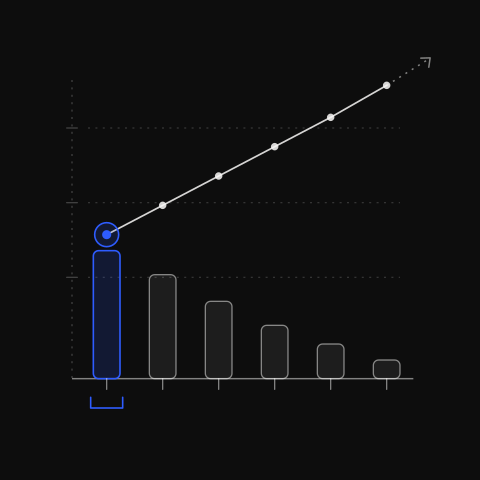
GFL QA Workflow

From initial risk assessment to continuous optimization, every engagement is aligned with your architecture, release model, business priorities, and product roadmap.
software testing services

Discovery & Risk Analysis

We examine requirements, architecture, environments, defect history, release cadence, current coverage, automation assets, and the business impact of failure.
quality assurance services

Test Strategy & Implementation

GFL QA consulting defines test strategy, prepares environments and data, sets traceability, builds automation, and implements quality gates.

QA software testing

Continuous Quality Optimization

We analyze execution data, defects, unstable tests, incidents, and delivery constraints to improve coverage, speed, and release confidence.

GFL QA Service Portfolio

  • QA Strategy and Planning – We turn product goals and risks into a clear testing plan.
  • Functional Testing – We validate business logic, workflows, and requirements.
  • Test Automation – We build stable UI, API, and regression test suites.
  • API and Integration Testing – We verify data exchange, contracts, and system integrations.
  • Performance Testing – We measure speed, load, and scalability under stress.
  • Security Testing – We check vulnerabilities, access control, and data protection.
  • Accessibility Testing – We ensure products are usable for all users and devices.
  • Compatibility Testing – We test across browsers, devices, and environments.
  • Regression Testing – We confirm core features work after changes and releases.
  • Production Monitoring – We track issues in real use to improve quality over time.
QA services
Principles

Preventive
Quality
Confident
Releases

From risk analysis to production monitoring, GFL builds a structured QA process that reduces release uncertainty. We integrate specialists into your workflow while keeping full product ownership and control.

Feel Free to

Contact Us

GFL QA Expertise

GFL combines test strategy, manual and automated testing, performance and security checks, and release governance in one streamlined QA model focused on product risk and business impact.

  • Risk-Based Testing – Focus on critical workflows, integrations, and high-impact failure points.
  • Shift-Left QA – Define quality requirements early to reduce rework.
  • Test Automation – Build scalable, maintainable automation frameworks.
  • Quality Gates – Ensure only validated changes move forward.
  • Test Data Setup – Create secure, realistic datasets for testing.
  • Defect Analysis – Identify root causes and prevent recurring issues.
  • Release Control – Define clear approval and rollback rules.
  • Continuous Improvement – Optimize quality metrics with every release.
quality assurance service

QA Solutions by Industry

  • Healthcare – We validate clinical workflows, patient-facing applications, integrations, access controls, data accuracy, and reliability across sensitive digital environments.
  • Banking and Finance – GFL tests payment, lending, investment, account, and reporting platforms where transaction integrity and traceable change are critical.
  • Retail and E-Commerce – We protect search, catalog, pricing, checkout, payment, promotion, fulfillment, and high-traffic customer journeys.
  • SaaS and Technology – Continuous testing supports frequent releases, multi-tenant architectures, subscription workflows, integrations, and rapid product evolution.
  • Telecommunications – GFL verifies distributed customer platforms, billing processes, service activation, integrations, and performance under large transaction volumes.
  • Manufacturing and Logistics – We test operational software, IoT-connected workflows, warehouse systems, planning tools, and supply-chain integrations where downtime disrupts execution.
software quality assurance services

Business Growth

GFL improves the economics and predictability of software delivery by making quality measurable, repeatable, and directly connected to business risk.

01/

Faster Feedback

Automated checks and clear test priorities shorten the time between a code change and an actionable quality decision.

02/

Fewer Escaped Defects

Risk-based coverage and structured release validation reduce the number of critical failures that reach customers and operations.

03/

Lower Quality Cost

Earlier detection, reusable automation, and better defect prevention reduce expensive rework, emergency fixes, and repeated manual effort.

04/

Clearer Release Decisions

Traceable results, readiness criteria, and risk reporting replace subjective approval with evidence-based decisions.

05/

Scalable Coverage

A standardized test architecture supports more features, platforms, releases, and teams without multiplying coordination overhead.

GFL QA Technology Stack

GFL selects tools according to product architecture, delivery pipelines, security requirements, team skills, and long-term maintainability.

  • Test Management & Collaboration – Jira, Azure DevOps, TestRail, Zephyr, Xray
  • Web Automation – Playwright, Selenium, Cypress, WebdriverIO
  • Mobile Testing – Appium, Espresso, XCUITest, BrowserStack, Sauce Labs, Firebase Test Lab
  • API & Integration Testing – Postman, REST Assured, SoapUI, Karate, Pact
  • Performance Testing – Apache JMeter, k6, Gatling, Locust
  • Security & Accessibility – OWASP ZAP, Burp Suite, axe-core, Lighthouse, WAVE
  • CI/CD & Quality Gates – Jenkins, GitHub Actions, GitLab CI/CD, Azure DevOps Pipelines, CircleCI
  • Observability & Reporting – Allure, ReportPortal, Grafana, Prometheus, Datadog, Sentry, Elastic Stack
quality assurance in software testing

Build Quality Into Every Release

GFL creates practical QA systems that improve coverage, accelerate feedback, and reduce production risk without slowing delivery. Start with one critical product flow, release pipeline, or quality bottleneck, then expand based on measurable results.

software quality assurance

FAQ QA Services

FAQ.

GFL tests web, mobile, desktop, cloud, API-driven, data-intensive, and enterprise applications, including integrations, migrations, upgrades, and multi-platform user journeys.

Yes. We retain effective tools, processes, and ownership models, then strengthen only the gaps that limit coverage, speed, traceability, or release confidence.

A focused assessment or automation pilot may take several weeks, while broader transformation is delivered in controlled phases aligned with product priorities.

We track requirement coverage, execution progress, defect leakage, automation stability, test duration, release readiness, production incidents, and recovery trends.

GFL can provide stabilization testing, production validation, regression maintenance, quality reporting, process optimization, documentation, and knowledge transfer.